
Direct-to-Case Printing vs. Print-and-Apply Labeling: Which Is Better?
Direct-to-case printing is often a cost-effective alternative to print-and-apply labeling for manufacturers that need to print product information, barcodes, logos, and identification codes directly onto corrugated shipping boxes. By eliminating label materials and application steps, industrial inkjet printing can simplify packaging operations and reduce ongoing costs.
However, direct printing is not the best choice for every application. Print-and-apply labeling may be preferable when you need flexible placement options like corner wraps, multiple label placements, or specific retailer requirements.
For manufacturers interested in direct case coding, this article will help identify opportunities to reduce costs without compromising print quality or traceability.
What Is Direct-to-Case Printing?
Direct-to-case printing uses an industrial inkjet printer to apply text, graphics, barcodes, and other product information directly onto a shipping case or corrugated carton as it moves through a production or packaging line.
Instead of printing information on a separate label, the printer applies ink directly to the packaging material. Depending on the printer, ink, and substrate, manufacturers can print information such as:
- Product names and identification numbers
- Lot numbers, batch codes and date codes
- Linear barcodes and two-dimensional (2D) codes
- Shipping and handling information
- Company logos and product graphics
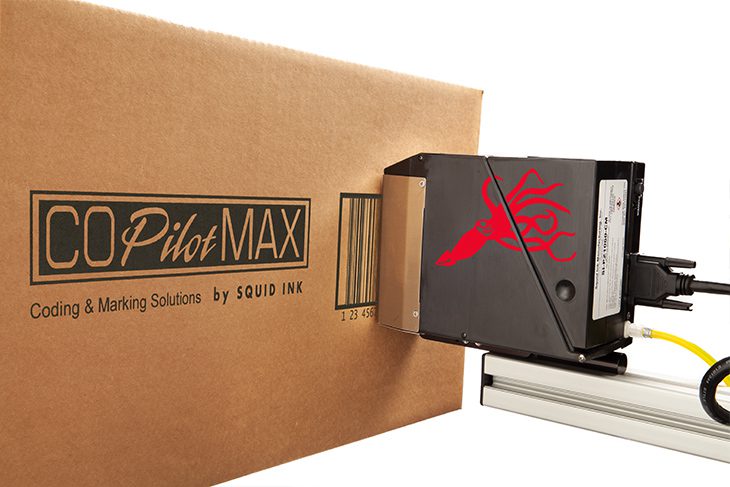
High-resolution industrial inkjet systems, such as Squid Ink’s CoPilot product family, support applications requiring large characters, detailed text, scannable barcodes, and logos. The CoPilot Max LT is especially useful for cartons with uneven, recessed, or irregular surfaces because its increased print throw distance accommodates greater variation between the printhead and the product. The CoPilot Gemini is another impressive printer offering a 5.6” print height and 360 dpi.

Learn more about the CoPilot Printing Systems – Hi-Resolution Printers – Squid Ink
Learn more about the CoPilot Max LT – CoPilot Max LT High-Quality Industrial Printing Solutions – Squid Ink
Learn more about the CoPilot Gemini – CoPilot Gemini High-Quality Industrial Printing Solutions – Squid Ink
What Is Print-and-Apply Labeling?
Print-and-apply labeling prints information onto a pressure-sensitive label and automatically applies that label to a carton or shipping case.
These systems are widely used in distribution, warehousing, and manufacturing environments where a standardized label format is needed.
A typical print-and-apply label may contain a product description, shipping address, routing information, handling instructions, and one or more barcodes.
The main difference is that the label provides a separate, controlled surface for printing. This helps when the corrugated material has inconsistent color or texture, or when a retailer requires a specific label format.
The trade-off is that you must purchase and manage labels, adhesives, and other consumables, and the system must print and apply each label reliably.
Direct-to-Case Printing vs. Print-and-Apply Labeling: Key Differences
| Consideration | Direct-to-case printing | Print-and-apply labeling |
| Consumables | Ink | Labels, adhesives and potentially ribbons, depending on the system |
| Application process | Prints directly onto the carton | Prints a label, then applies it on the carton |
| Changeovers | Digitally updates print messages; no label stock change for each design | Requires manual label stock changes, format adjustments or updates |
| Print surface | Depends on carton color, texture, coating and ink compatibility | Provides a separate label surface |
| Large characters | Suitable with appropriate large-character inkjet systems | Depends on label size and printer/applicator capability |
| Barcodes | Prints excellent quality when contrast, placement, and substrate are suitable | Advantageous when a consistent background is required |
| Uneven or recessed surfaces | Requires suitable printhead positioning and throw distance | Application method must accommodate the carton geometry |
| Complex shipping information | Suitable within the printer’s layout and print-quality capabilities | Preferable for dense information |
| Inventory | Reduces label stock and preprinted carton requirements | Requires label stock, adhesives, ribbons, and associated inventory management |
| Best fit | High-volume, repeatable case coding and identification | Detailed logistics labels and applications with specific labeling requirements |
Neither method is universally better. The goal is to select the technology that meets operational requirements at the lowest total cost of ownership.
How Much Does Direct-to-Case Printing Cost Compared with Labeling?
Direct-to-case printing reduces packaging costs by eliminating label materials and reducing the labor, maintenance, and inventory associated with a labeling process. Actual savings depend on the number of cases printed, label specifications, ink coverage, line speed, labor requirements, and equipment configuration.
To make a meaningful comparison, evaluate both methods over the same production volume and time period.
1. Consumables
Print-and-apply systems require labels and may also use ribbons or other consumables, depending on the printing technology. Direct inkjet printing primarily uses ink, with maintenance related costs varying by system.
The Squid Ink CoPilot Max LT’s costs are typically around one-tenth the cost of paper labels. This is not a guarantee of total operating-cost savings for every application. Actual results depend on the label being replaced, the printed message, ink usage, and operating conditions.
2. Labor and Production Time
A print-and-apply system must produce a label and apply it to the package. Direct printing eliminates the separate label-application step.
Potential savings include less time spent loading label rolls, managing label stock, correcting application problems, and performing changeovers.
3. Label Inventory and Storage
Manufacturers that use different labels for individual products, customers, or shipping destinations may need to stock multiple label formats.
Direct printing can reduce this inventory by letting operators select or update digital messages instead of changing physical label stock. It can also reduce the need for preprinted cartons when product identification can be printed on demand.
4. Equipment and Integration
A fair comparison must account for initial equipment cost, installation, mounting hardware, controls, line integration, and any required inspection equipment.
5. Waste, Rework and Downtime
Labeling may involve misapplied labels, wrinkles, or adhesive problems. Direct printing creates less waste and downtime because all prints are digitally controlled, enabling quick changeovers.
When comparing both printing methods, include the cost of rejected cases, rework, consumable waste, and downtime.
A practical cost comparison
Use your actual operating data to calculate annual costs:
| Cost factor | Direct printing | Print-and-apply |
| Ink and label materials | Annual ink and maintenance costs | Annual label, ribbon, related supply costs and maintenance costs |
| Labor | Loading, message changes, and maintenance | Label loading, setup, application troubleshooting, maintenance, and changeovers |
| Equipment | Printer, controller, mounting and integration | Printer, applicator, controls and integration |
| Downtime and rework | Cost of print defects | Cost of application failures and label defects |
| Inventory and storage | No consumables or preprinted carton inventory needed | Label stock storage and inventory management |
Annual operating cost per method can be estimated by adding consumables, labor, maintenance, downtime, waste, and inventory costs. Include annualized equipment and installation costs when comparing total ownership costs.
Can You Print Barcodes and Logos Directly on Corrugated Cartons?
Yes. Industrial inkjet printers can print barcodes, logos, product information, and variable data directly onto suitable corrugated cartons.
The important consideration is not simply whether the printer can produce the image. The printed code must remain readable by the scanners used throughout the supply chain.
Successful direct barcode printing depends on:
- Print resolution: Fine bars, small text, and detailed graphics require appropriate resolution.
- Contrast: The ink and carton surface must create sufficient contrast for reliable scanning.
- Substrate quality: Corrugation, fibers, coatings, surface color, and carton variation can affect print results.
- Placement: The code must be printed in an appropriate location and orientation.
- Line consistency: Changes in carton position, speed, or printhead distance can affect the result.
Squid Ink’s CoPilot Max, CoPilot Gemini, and CoPilot Max LT deliver high-resolution printing of text, barcodes, and logos while supporting GS1 standards compliance.
How Do You Print on Uneven or Recessed Cardboard Surfaces?
Uneven surfaces can challenge conventional inkjet systems because print quality may change as the distance between the printhead and the carton varies.
Bulging flaps, recessed panels, angled surfaces, and inconsistent carton handling can all affect print placement and readability.
Squid Ink’s CoPilot Max LT is designed for these demanding applications. Its extended throw distance of up to 12 mm lets the printhead print from farther away than conventional close-range setups, allowing greater tolerance for variations in product position and surface geometry.
Its active ink system also lets the printhead tilt or rotate without requiring corresponding adjustments to the ink supply. These capabilities can help manufacturers print on irregular cases while maintaining a practical production-line setup.
However, extended throw distance does not eliminate every surface-related challenge. Severe carton movement, deep recesses, poor contrast, and unsuitable ink or substrate combinations can still affect results. Test representative cartons under actual operating conditions before selecting a system.
When Does Direct-to-Case Printing Make the Most Sense?
Direct printing often fits well when manufacturers want to reduce label use, simplify packaging operations, or print identification information on demand.
Common applications include:
- Food and beverage cases requiring product identification, batch codes, or traceability information
- Consumer goods cartons require logos, item numbers, and handling information
- Industrial products shipped in corrugated cases
- High-volume operations seeking to reduce recurring label costs
- Production lines with frequent product changes that can be managed through digital message selection
- Packaging operations where large characters or graphics are needed directly on the carton
Direct printing is particularly attractive when the same carton can receive different product information without requiring a separate label for every variation.
When Is Print-and-Apply Labeling the Better Choice?
Print-and-apply labeling remains valuable with specific labeling formats.
Consider retaining or selecting a labeler when:
- A retailer or customer specifies a particular label format or placement.
- The carton surface is too inconsistent to produce reliable direct-print results.
- The label must contain extensive shipping, routing, or destination information.
- The operation requires multiple labels on different carton faces.
- Adhesion, label placement, or a standardized label background is essential.
How Can You Reduce the Cost of Case Coding and Labeling?
Start by examining the complete case-coding process rather than focusing only on consumable prices.
- Calculate the cost per case. Include label materials, ink, labor, maintenance, downtime, rework, and inventory.
- Identify unnecessary labels. Determine whether information currently printed on a label could be printed directly onto the carton.
- Reduce label and carton variations. Digital printing can make it easier to use common packaging materials across multiple products.
- Review production-line efficiency. Determine whether removing a label-application step could simplify handling or reduce bottlenecks.
- Match the printer to the carton. Consider substrate, surface irregularities, required print height, and production speed.
- Validate print quality before conversion. Test barcode readability, print durability, and performance on representative cartons.
- Compare total ownership costs. Include equipment investment and installation rather than relying solely on consumable comparisons.
A structured evaluation helps manufacturers identify where direct-to-case printing can deliver measurable savings and where labeling is the more reliable option.
Frequently Asked Questions
How can I print directly on corrugated boxes without labels?
Use an industrial inkjet printer designed for corrugated packaging. The printer deposits ink directly onto the carton to produce product codes, text, barcodes, and logos. Select an ink and printhead configuration suited to the carton surface and verify print quality under actual production conditions.
What is the best alternative to print-and-apply labels?
Direct-to-case inkjet printing is a common alternative when you can print the required information clearly and reliably on the carton. It eliminates label materials and the application step.
What printer can print large characters on shipping cases?
A large-character industrial inkjet printer, such as the Squid Ink CoPilot Gemini, CoPilot Max LT, or CoPilot Max, can print text, logos, and other information directly onto shipping cases.
Can I print barcodes and logos directly onto corrugated cartons?
Yes. Industrial inkjet systems can print both barcodes and logos directly onto suitable cartons. Ensure the print has adequate resolution, contrast, and placement, and verify that barcodes meet the applicable scanning and quality requirements.
How do I print on uneven or recessed cardboard surfaces?
Choose a printer with sufficient throw distance and mounting flexibility to accommodate variation in carton position. The CoPilot Max LT offers an extended throw distance of up to 12 mm, making it suitable for many overfilled, recessed, angled, or irregular surfaces. Test actual cartons to confirm performance.
Is direct-to-case printing cheaper than print-and-apply labeling?
Yes, it can be, especially in high-volume applications where labels are used on every case. Direct printing can reduce consumable costs, label inventory, and labor for application. The actual savings depend on label pricing, ink consumption, equipment costs, maintenance, and production conditions.
Can direct printing replace every shipping label?
No. Direct printing is not a universal replacement for shipping labels. Some customers, retailers, and distribution systems require specific label formats, placement, or extensive variable information. Evaluate those requirements before changing the packaging process.
Find the Right Direct-to-Case Printing System for Your Application
Reducing label costs does not have to mean compromising product identification or traceability. With the right industrial inkjet system, manufacturers can print directly onto corrugated cartons, streamline packaging workflows, and reduce reliance on labels.
Squid Ink’s CoPilot product family offers high-resolution printing options for a range of case-coding applications, from standard product identification to larger graphics and printing on uneven or recessed surfaces.
Ready to evaluate direct-to-case printing for your production line? Explore Squid Ink’s CoPilot printing systems to determine which configuration best fits your carton, print requirements, and production environment.
